Pending payments in LATAM: why they pile up and when they should expire
Payments stay pending in Latin America because many popular methods are asynchronous: the customer gets a reference now and pays minutes, hours or days later, or never. A pending payment should expire once it passes the normal resolution window for its payment method, and that window is very different for a card, an instant transfer and a cash voucher.
Below: where pending comes from, how to split it into the three situations it hides, and an expiry guide by payment method that ops teams can adapt.
Why do pending payments pile up in Latin America?
Cards are synchronous. The issuer answers in seconds. A card payment is pending only for a short time, usually while the customer completes authentication.
A large part of Latin American checkout works differently. The customer picks a bank transfer, a Pix QR code, a Boleto or a cash voucher. The merchant creates a payment with a reference. The money moves later, through another channel, and the confirmation comes back later still.
Between those two moments the payment is pending. That is normal. The trouble starts when nothing ever closes it.
Three things make the pending pile larger in this region:
- Cash is still a real payment method. A customer paying with a cash voucher at a convenience store has to get to the store first.
- Some methods are built around a due date. A Boleto, or a Pix charge with a future due date, is meant to be paid later. The Central Bank of Brazil's SPI annual report describes charges with a future due date as a separate flow from instant Pix.
- Confirmations travel through several systems. The customer's bank, the rail, the PSP and your own platform. Each hop is a place where a status can get lost.
What is actually inside "pending"?
In most payment dashboards, pending holds three different situations.
- A customer who is about to pay. The reference exists, the money has not arrived, and it is still inside the normal window for that method.
- A customer who never will. They generated a voucher, changed their mind, or paid with another method. Without an expiry rule, that reference stays pending forever.
- A payment that is stuck. The PSP processed it, but the final status never reached your system. Or it sits in a manual review queue and nobody is looking at it.
Only the first group is truly pending. The second should be expired. The third is an operations problem that needs a status check or a person.
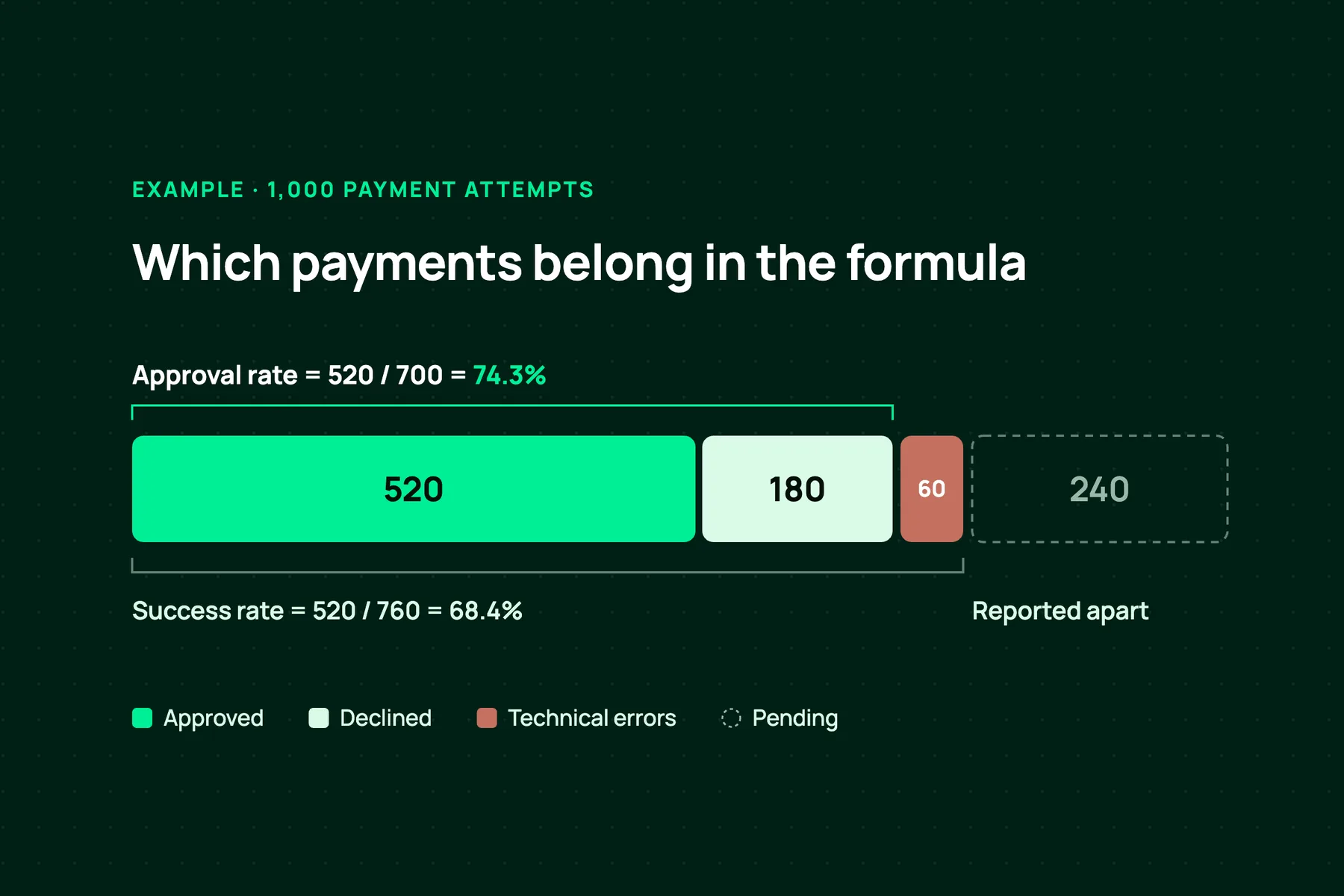
Mixing them has a cost. Approval rate drops because pending sits in the denominator. Volume looks larger than what was paid. Support chases payments that were never coming and misses the ones that are stuck.
When should a pending payment expire?
Each method runs on its own clock. Instant rails confirm in seconds, so a long pending there is a warning sign. Cash and due date methods are slow by design, so a long pending there is expected until the due date passes.
Some official reference points:
- SPEI (Mexico). Banco de México says SPEI payments should not take more than 30 seconds after approval. The electronic payment receipt (CEP) can take up to 30 minutes to be available.
- Pix (Brazil). The Central Bank of Brazil states that Pix can be made 24 hours a day, every day of the year, weekends and holidays included, with funds credited within 10 seconds in 99% of transactions.
- PSE (Colombia). The customer authorizes a debit from their bank account through their own online banking. PSE states a maximum processing time of 21 minutes per transaction.
- Boleto (Brazil). Since March 2024, a Boleto paid by 1:30 pm can settle the same day; after that it settles the next business day. When the payee receives the funds also depends on its contract with its bank.
Expiry by payment method
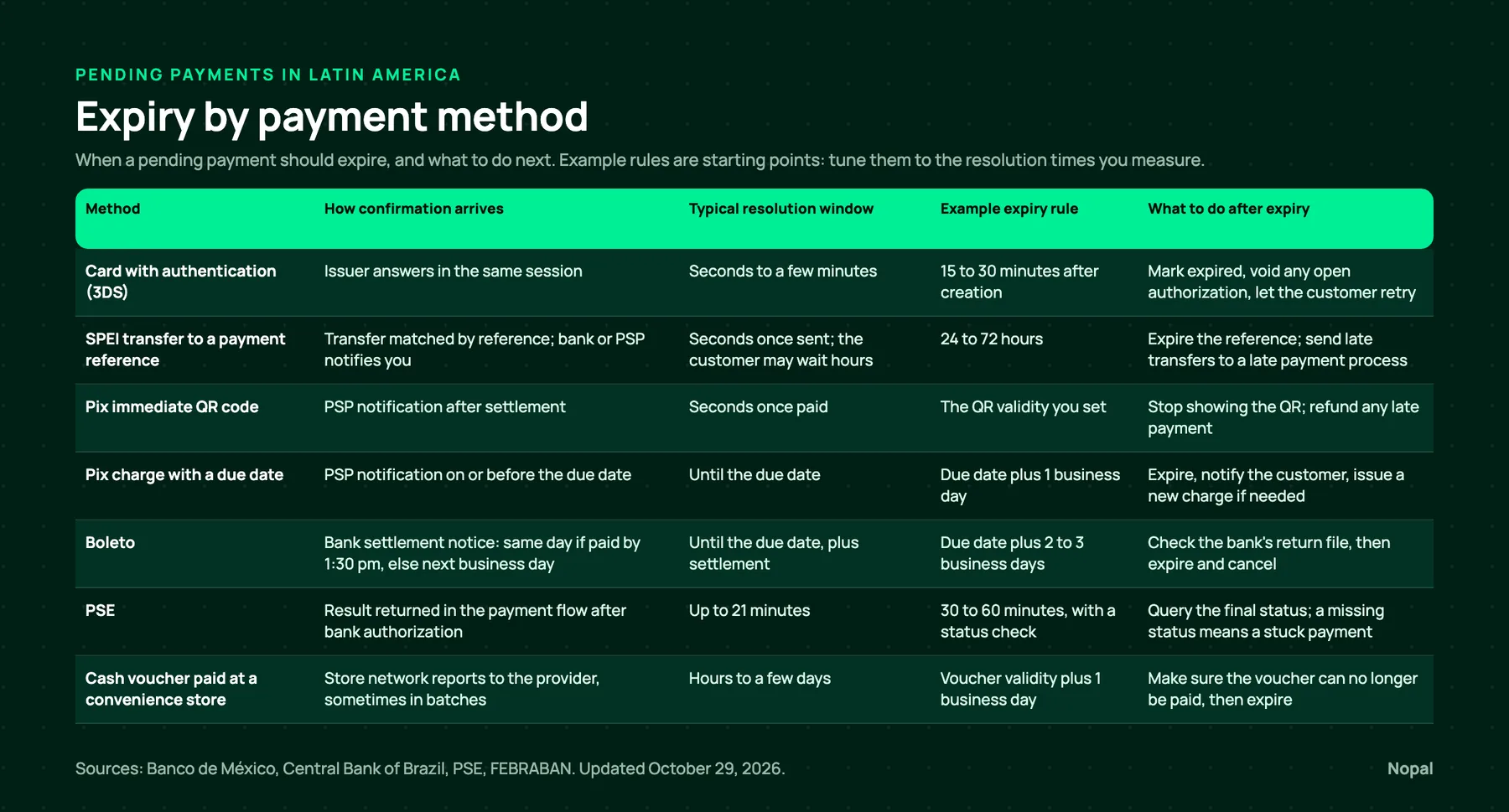
Card with authentication (3DS)
- How confirmation arrives: the issuer answers in the same session; the payment is pending only while the customer authenticates.
- Typical resolution window: seconds to a few minutes.
- Example expiry rule: 15 to 30 minutes after creation.
- What to do after expiry: mark it expired, void any open authorization, let the customer retry.
SPEI transfer to a payment reference
- How confirmation arrives: the incoming transfer is matched by reference; the bank or PSP notifies you.
- Typical resolution window: seconds once sent, but the customer may wait hours before sending.
- Example expiry rule: 24 to 72 hours.
- What to do after expiry: expire the reference; route any later transfer to a late payment process (credit or refund).
Pix immediate QR code
- How confirmation arrives: PSP notification after settlement.
- Typical resolution window: seconds once paid.
- Example expiry rule: the QR validity you set, then expire.
- What to do after expiry: expire the charge and stop showing the QR; refund any late payment.
Pix charge with a due date
- How confirmation arrives: PSP notification on payment, on or before the due date.
- Typical resolution window: until the due date.
- Example expiry rule: due date plus 1 business day.
- What to do after expiry: expire, notify the customer, issue a new charge if they still want to pay.
Boleto
- How confirmation arrives: settlement notice from the bank; same day if paid by 1:30 pm, otherwise next business day.
- Typical resolution window: until the due date, plus settlement time.
- Example expiry rule: due date plus 2 to 3 business days.
- What to do after expiry: check the bank's return file before closing; then expire and cancel the Boleto.
PSE
- How confirmation arrives: the result is returned in the payment flow after the customer authorizes at their bank.
- Typical resolution window: up to 21 minutes, according to PSE.
- Example expiry rule: 30 to 60 minutes, with a status check before closing.
- What to do after expiry: query the final status; a missing status means a stuck payment that needs follow up.
Cash voucher paid at a convenience store
- How confirmation arrives: the store network reports to the provider, which notifies you, sometimes in batches.
- Typical resolution window: hours to a few days, depending on voucher validity and the network.
- Example expiry rule: voucher validity plus 1 business day.
- What to do after expiry: make sure the voucher can no longer be paid, then expire; plan for late payments.
The example rules are starting points. Replace them with the resolution times you measure.
How do you tell a stuck payment from a slow one?
Measure resolution time by method and by PSP. For each method, find how long paid payments took to move from pending to paid. Example: if 95% of paid SPEI references were paid within 6 hours, a SPEI payment still pending after three days is either abandoned or stuck.
Before you expire anything, run three checks:
- Ask the provider for the current status. Do not rely only on the webhook that never came.
- Look for the funds. For SPEI, Banco de México lets you look up the CEP for payments made in the last 45 working days. A transfer sent with a wrong or missing reference can sit unmatched while the order stays pending.
- Check the manual review queue. A payment held for review is waiting on your team. The customer can do nothing to move it.
Manual review deserves its own rule. Give the queue an owner and a time target. Alert when a payment ages past it. Without that, reviewed payments quietly join the pending pile.
What should happen after a payment expires?
Make "expired" a real status, separate from "declined". Declined means a bank or the provider refused the payment. Expired means nothing happened in time. They have different causes and different fixes.
Then close the loop:
- Take expired payments out of the approval rate and report them as their own rate, by method.
- Tell the customer and offer a new payment. Do not reuse the old reference.
- Decide in advance what happens to late money. With push methods such as transfers and cash vouchers, funds can still arrive after expiry. Credit the order or refund it, but log the decision.
- Reconcile every day. An expired reference should match no funds. If it does, it was a stuck payment, and your window or your status checks need work.
The takeaway
A payment pending for a week is not pending anymore. Give every method its own clock, check the status before you close anything, and give expired payments their own name.
Frequently asked questions
- Is a pending payment the same as a failed payment?
- No. A pending payment has not reached a final status yet. It can still be paid, expire or turn out to be stuck. Close it only once it is paid, declined or expired.
- How long does a SPEI transfer take to arrive?
- Banco de México says SPEI payments should not take more than 30 seconds after approval. When a SPEI payment stays pending for long, the delay is usually the customer not sending it yet, or a transfer that could not be matched to its reference.
- Should expired payments count in the approval rate?
- No. Expired payments were never accepted or declined. Report them as a separate expiry or abandonment rate by method, so a cash voucher problem does not hide a card problem.
- What if the money arrives after the payment expired?
- Treat it as a late payment on the original order. Match it, then credit it or refund it according to a rule you set in advance.
- Can a Boleto still be paid after its due date?
- It depends on how the Boleto was issued. Some accept late payment with fees, others are blocked after the due date. Check the settings with the issuing bank, and set your expiry rule after that date.
- How often should expiry rules be reviewed?
- Whenever you add a payment method or a PSP, and on a regular schedule otherwise. Resolution times change as customer habits and provider systems change.