PSP, gateway, aggregator, orchestrator: what's the difference?
A PSP processes your payments and settles the money to you. A gateway carries payment data and never touches the funds. An aggregator onboards you under its own master account and receives your money before passing it on. An orchestration layer connects one checkout to several PSPs, so you can work with the right provider in each market without rebuilding your integration.
The four terms get mixed up in sales calls, contracts and RFPs. The mix-up has a cost: months of rework, or funds held by a company you never meant to depend on. The quickest way to tell them apart is to ask one question about each: who holds your money?
What does a PSP do?
A payment service provider, or PSP, handles the payment from end to end. It connects to acquirers, banks and local payment networks, accepts the methods it supports, processes each transaction and usually settles the funds to your bank account on a fixed cycle.
You sign a contract with the PSP and go through its onboarding. Pricing, settlement terms, reserves and the methods you can offer all come from that contract.
In Latin America, a PSP often matters as much for its local methods as for cards: SPEI transfers in Mexico, Pix in Brazil, PSE in Colombia, and cash vouchers paid at convenience stores.
What does a payment gateway do?
A gateway is the technical connection between your checkout and a processor. It encrypts the payment data, sends it to the processor and returns the response. Some gateways add a hosted payment page, tokenization or fraud screening.
A gateway does not move money. Visa classifies gateway and processing services among third party agents that do not get involved in the movement of funds. You still need an acquirer or a PSP to process and settle the payment.
Many PSPs include a gateway in their offer. That is why the two words are often used as if they meant the same thing.
What is a payment aggregator?
An aggregator, also called a payment facilitator or master merchant, onboards you as a sub-merchant under its own account with an acquirer. Visa describes a payment facilitator as a third party agent that can sign an acceptance agreement with a seller on behalf of an acquirer, and receive settlement proceeds from the acquirer on behalf of that seller.
Onboarding is fast, because the aggregator already carries the relationship with the acquirer. The trade off is dependence. Your account lives inside theirs, under their risk appetite and their terms. If their rules change, or your profile stops fitting them, your account can be reviewed or closed with little notice, and your funds follow their schedule.
What is a payment orchestration platform?
A payment orchestration layer sits above several PSPs. You integrate once, and the platform connects you to the providers that fit each market and payment method. It puts their responses and reports into one format, and lets you add or change a provider without touching your checkout.
An orchestration platform is not a PSP. The payments are still processed and settled by the PSPs underneath. Depending on the platform, you sign the PSP contracts directly or the platform arranges them. Ask which one before you sign.
Who holds your money in each setup?
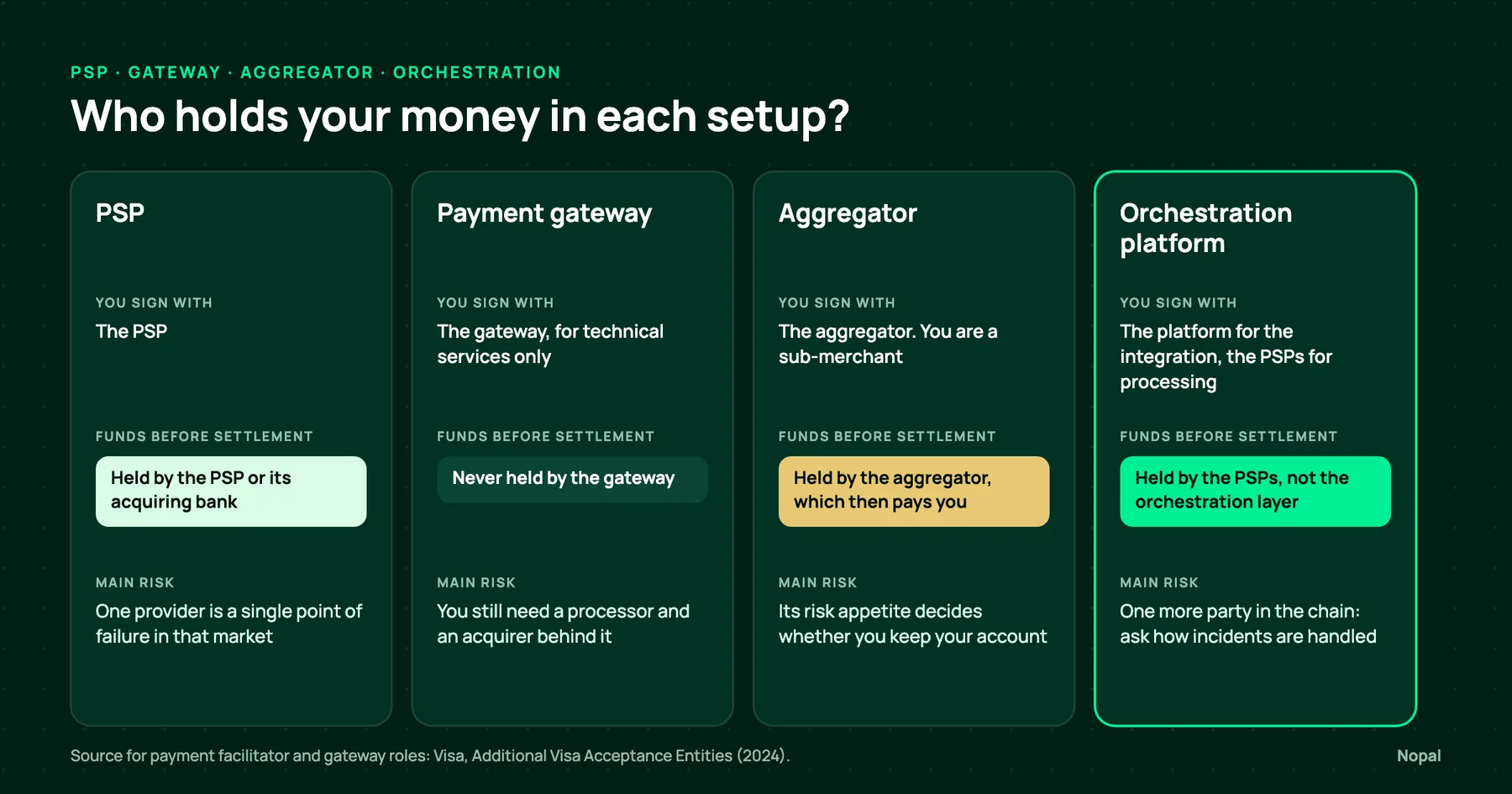
PSP
- You sign with: the PSP.
- Funds before settlement: held by the PSP or its acquiring bank.
- Main risk: one provider is a single point of failure in that market.
Payment gateway
- You sign with: the gateway, for technical services only.
- Funds before settlement: never held by the gateway.
- Main risk: you still need a processor and an acquirer behind it.
Aggregator (payment facilitator)
- You sign with: the aggregator. You are a sub-merchant.
- Funds before settlement: held by the aggregator, which then pays you.
- Main risk: its risk appetite decides whether you keep your account.
Payment orchestration platform
- You sign with: the platform for the integration, and the PSPs for processing.
- Funds before settlement: held by the PSPs, not the orchestration layer.
- Main risk: one more party in the chain. Ask what happens to your payments if the platform has an incident.
When is a single PSP enough?
One PSP is often the right way to start. It usually fits when:
- You sell in one country, with one or two payment methods.
- Your PSP covers the local methods your customers use.
- Your team can live with one dashboard and one report format.
The setup starts to strain when:
- You sell in three or four markets, with local methods in each.
- One incident at your PSP can stop all your revenue in a country.
- You need a second provider for continuity, and your team would have to build and run a second integration.
- Every provider reports declines in its own format, and comparing them takes days.
That is usually the point where an orchestration layer starts to make sense.
What should you ask before you sign?
- Who holds my funds before settlement, and on what schedule?
- Is the merchant account in my name, or am I a sub-merchant?
- What happens to my account if your risk policy changes?
- Which local payment methods are live today, and in which countries?
- If I add a second provider later, what changes in my integration?
The answers tell you which of the four you are actually buying, whatever the sales deck calls it.
Frequently asked questions
- Is a payment gateway the same as a PSP?
- No. A gateway carries payment data between your checkout and a processor. A PSP processes the payment and settles the funds. Many PSPs include a gateway, which is why the terms get mixed up.
- Is a payment aggregator the same as a payment facilitator?
- In practice, yes. Visa uses payment facilitator, master merchant and merchant aggregator for the same model: a company that onboards sellers under its own acquirer relationship and receives their funds before paying them.
- Does a payment orchestration platform hold my funds?
- In most setups, no. Settlement comes from the PSPs connected to the platform. Check the contract: if the platform collects funds on your behalf, it is also acting as a payment intermediary.
- Can one company be a PSP, a gateway and an aggregator at the same time?
- Yes. Many providers combine several roles. What matters is the role they play in your contract: who you sign with, and who receives your funds.
- When should a merchant add a payment orchestration layer?
- When you work, or plan to work, with several PSPs across markets, and maintaining separate integrations, dashboards and reports starts to slow your team down.